

Difference between Sage 200 and Sage 300 explained. Learn features, pricing, scalability, and which Sage ERP is best for your business.
Both Sage 200 and Sage 300 are Sage’s mid-market ERP products, designed to help businesses move beyond basic accounting software. They share a common goal increasing efficiency and facilitating growth but they target different business profiles and offer different levels of capability.
Sage 200
Sage 200 is designed for small to medium-sized enterprises (SMEs) that need more functionality than entry-level accounting software but do not require the full complexity of a large enterprise ERP.
Key features:
- Financial management (general ledger, accounts payable/receivable)
- Inventory control and order management
- CRM integration for customer relationship management
- Business intelligence and reporting tools
- Scalability for growing SMEs
Sage 200 is a strong choice for businesses with straightforward multi-department operations, a domestic focus, and budget constraints that make a full enterprise ERP unjustifiable.
Sage 300
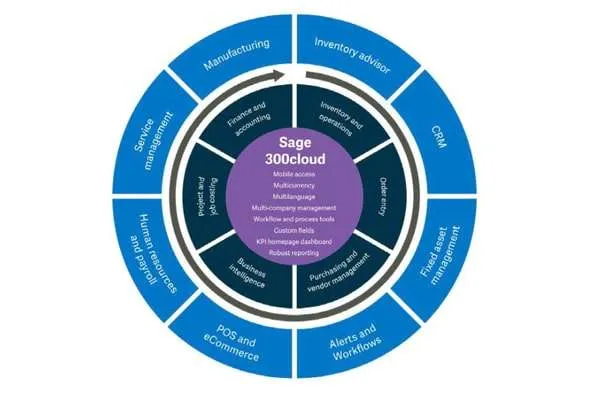
Sage 300 is an ERP system designed for larger companies and multinational organizations with more complex operational needs.
Key features:
- Comprehensive ERP functionality across finance, operations, and distribution
- Multi-currency and multi-lingual support for global operations
- Advanced customization options for industry-specific workflows
- Enterprise-wide integration across multiple business units
- Robust reporting and analytics with Power BI integration
- Project and job costing modules
Sage 300 is the right choice for businesses that process transactions in multiple currencies, manage multiple legal entities, need advanced inventory and project costing, or operate across international locations.
Key Differences at a Glance
| Factor | Sage 200 | Sage 300 |
|---|---|---|
| Target audience | SMEs | Mid-large enterprise |
| Global operations | Limited | Strong |
| Multi-currency | Basic | Advanced |
| Customization | Moderate | Extensive |
| Integration | Standard | Robust enterprise |
| Implementation complexity | Moderate | Higher |
Which One Is Right for Your Business?
Choose Sage 200 if you are a growing SME focused primarily on domestic operations with straightforward accounting and inventory needs.
Choose Sage 300 if you manage multiple entities, operate internationally, need advanced project costing, or require deep customization for industry-specific workflows.
When in doubt, a Sage-certified consultant can assess your requirements and recommend the right platform.
Let us help you evaluate which Sage product fits your business best.